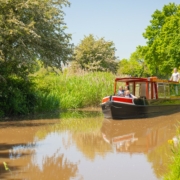
Tag Archive for: narrowboat holidays

Drifters prepares for a record narrowboat holiday season

Following confirmation that domestic holidays can resume on 12 April for single households, Drifters operators are preparing for a record number of canal boat holidays to be taken in Britain.

Drifters’ director Nigel Stevens explains:

“With the current focus on domestic holidays, narrowboat holidays have never been more popular, and many people are planning their first holiday on the canals this year.

“Drifters offers 550 boats from 45 locations across England, Wales and Scotland.  The peak spring and summer months are already booking up well.  But we still have availability, especially for single households from 12 April.  And two households or the ‘rule of six’ from 17 May.

“You don’t need a licence to steer a canal boat, and tuition is included in all our holiday packages.  Around 350,000 people enjoy narrowboating each year, and we are looking forward to welcoming more people to the waterways this year.

“Our narrowboats are equipped with everything you need on board for a self-catering holiday afloat.  There are over 3,000 miles of inland waterways to explore, with hundreds of waterside destinations.  From pubs and cafes, to museums and nature reserves, there’s always something special to plan at stop at.”

To celebrate, here are Drifters’ top six 2021 narrowboat holiday destinations:

Drift through the Calder Valley

On a short break from Drifters’ canal boat rental base at Sowerby Bridge in West Yorkshire, boaters can travel along the leafy Rochdale Canal to the old mill town of Hebden Bridge.  The route travels through the leafy Calder Valley.  It climbs through woods, fields and small stone towns. The journey to Hebden Bridge covers seven miles, 10 locks and takes around five and a half hours.  Once at Hebden, you can moor in the centre of town to enjoy a good choice of places to eat.  There are also stunning walks up to Heptonstall or Hardcastle Crags.

Travel round the Birmingham Ring

Drifters is opening a new narrowboat hire base at Kings Orchard Marina on the Coventry Canal in Staffordshire.  On a week’s break from Kings Orchard, canal boat holiday-makers can complete the Birmingham Ring.  This takes boaters on a waterway odyssey with a mixture of urban and rural landscapes.  These range from Gas Street Basin in the heart of Birmingham to Cannock Chase Area of Outstanding Natural Beauty in Staffordshire.

Float across ‘The Stream in the Sky’

On a short break from Drifters’ base at Trevor on the beautiful Llangollen Canal in North Wales, boaters can travel across the UNESCO World Heritage Pontcysyllte Aqueduct.  Then on to Ellesmere in the heart of the Shropshire Lake District.  On a week’s break, boaters can continue on to the historic market town of Whitchurch.

Cruise to the ancient City of Chester

Drifters has a canal boat hire base on the Shropshire Union Canal at Bunbury near Tarporley in Cheshire.  On a short break from there, canal boat holiday-makers can head north to the historic City of Chester.  This 12-mile journey through the rolling Cheshire countryside takes seven hours, passing through 18 locks.

Travel round the Droitwich Ring

From Drifters’ base at Worcester, canal boat holiday-makers can cruise round the Droitwich mini-ring.  The route takes canal boat holiday-makers on a 20-mile circuit of the Worcestershire countryside, passing through the historic spa town of Droitwich and the cathedral city of Worcester.  There are 33 locks and it takes around 16 hours, so it’s perfect for a short break.

Watch out for wildlife on the Ashby Canal

On a week’s holiday from Drifters canal boat hire base at Braunston, boaters can cruise to the pretty village of Snarestone and back.  The route travels 47 miles, passing through eight locks (four there and four back) in around 32 hours.  It takes boaters up the North Oxford Canal to Rugby, and on to Hawkesbury Junction to join the Coventry Canal.  Five miles later, the journey transfers onto the peaceful lock-free Ashbury Canal, which winds gently through countryside for 22 miles.  From Carlton Bridge to Snarestone, the canal is designated a Site of Special Scientific Interest (SSSI).  This recognises the diversity of its plant, insect and animal life.  Wildlife on the Ashby includes nine species of dragonfly, the water shrew, water vole and rare native white-clawed crayfish.


    Sculpture on the canals

    There are many engaging pieces of sculpture and public art to look out for along our waterways. Many of them celebrate their historic past and the wildlife that lives on the canals today.

    Some of the most famous sculptures that have appeared on our waterways have been temporary installations.  For example, Antony Gormley’s striking cast-iron cube figure that watched over Ned’s Lock on the Stratford Canal at Lowsonford in 2015.

    Here we’ve gathered together a list of sculptures permanently at home on Britain’s canal network, to watch out for on your next canal boat holiday:

    Jack o’ the Locks, Sowerby Bridge Wharf in West Yorkshire

    Sculpted by artist Richard Burnett in 2009, these two bronze life-size figures celebrate the industrial heritage of Sowerby Bridge, once the centre of the textile industry boom.  One of the figures is Richard Tiffany, the town’s lock keeper for many years.  By his side, helping him to push a lock gate is a young boy, modelled on Tiffany’s great grandson.

    Drifters has a narrowboat hire base at Sowerby Bridge wharf, which lies at the junction of the Rochdale Canal and Calder & Hebble Navigation.

    The Kelpies on the Forth & Clyde Canal in Scotland

    Standing at 30-metres high, the magnificent Kelpies are the largest pair of equine statues in the world.  Based on the heavy horses that once plied the canal towpaths, these mythical water horses stand at the gateway to the new extension to the Forth & Clyde Canal, taking it to Grangemouth.

    Narrowboat holiday-makers can reach the Kelpies in around four hours from Drifters’ canal boat hire base at Falkirk.

    Opening the Lock Gate, City Road Basin in London

    Sculptor Ian Rank-Broadley has been commissioned to create three bronze sculptures for the 250 City Road development, next to London’s Regent’s Canal.  Rank-Broadley is famous for his effigy of the Queen, which has appeared on all Commonwealth coins since 1998.  The first installation at City Road, which depicts two canal workers opening a lock gate, was unveiled at the entrance to the central plaza in March 2020.  It will be followed by a barge lady this summer, and a boat horse and his handler in 2023.

    Drifters nearest canal boat rental base is on the Kennet & Avon Canal at Aldermaston, around 37 cruising hours away.

    James Brindley, Coventry Basin

    Often referred to as the ‘father of English canals’, canal engineer James Brindley is commemorated at Coventry Basin with a 7ft bronze statue.  Created by renowned sculptor James Butler, the sculpture portrays Brindley dressed in 18th century clothing, poring over canal plans at a desk.  The statue is one of 39 artworks by local artists along the Canal Art Trail, which runs for 5.5 miles from Coventry Basin to Hawkesbury Junction.

    The nearest Drifters canal boat hire yard is on the North Oxford Canal at Rugby, around seven cruising hours away.

    The Dragonfly at Hatton in Warwickshire

    This eye-catching stainless steel sculpture of a dragonfly has landed on a side pond above Lock 42, on the Hatton Flight of the Grand Union Canal.  The sculpture, which measures 6ft across, was created by the Welsh sculptor Gideon Peterson.  Early in his career, Peterson worked for Sir Anthony Caro.  The sculpture, which was commissioned by British Waterways in 2006, celebrates the wildlife of the waterways.

    Canal boat holiday-makers can reach Lock 42 from Drifters narrowboat rental base at Warwick in around three and a half cruising hours.

    The ‘Hawk/Creation’ at Mytholmroyd in West Yorkshire

    Sculpted by the artist Kenny Hunter in 2013, a cast iron hawk can be seen next to the Rochdale Canal at Mytholmroyd.  The work was inspired by the poem ‘Hawk Roosting’ by the former Poet Laureate Ted Hughes.  Born in Mytholmroyd, Hughes spent his childhood years wandering the local fields and woods.

    The nearest Drifters base is at Sowerby Bridge, around three cruising hours away.

    Our holidays and the #RoadMapOutOfLockdown

    Following the Government’s announcement last night (22 February), sadly all our holidays booked to depart prior to 12 April have to be cancelled.

    We will contact everyone affected.  We will offer to either move or refund your holiday.  Please bear with us as this will take a little time.

    If you have an urgent query, please do email the Drifters operator you have booked with.

    Our holidays can resume from 12 April

    In line with current government guidance, we are now accepting bookings for holidays departing from Monday 12 April onwards.

    The current government guidelines allow only single households to travel together from 12 April.

    From 17 May, the rule of six or two households is likely to apply indoors.

    From 21 June all restrictions on social contact will hopefully be relaxed.

    Please note, all these dates are subject to change in line with government guidance.

    ‘Top of the locks’ narrowboat holiday destinations for 2021

    There are over 1,800 locks on the 2,000 miles of navigable waterways in England and Wales.  Locks allow boats to travel up and down hills, and have been around for hundreds of years.

    With around 35,000 boats licenced to cruise the canals, there are approximately 3.85 million lockages (uses of a lock) each year.

    A lock is simply a chamber with gates at either end, and canal boat holiday-makers follow a series of step-by-step tasks to use them.  By emptying or filling the chamber with water, boats can move up or down onto a new section of waterway.

    There are many different kinds of locks

    From narrow and broad, to staircase and double, there are many different kinds of locks.  But they all on work on a similar principle.  With the lock gates closed, boaters should open the sluices (paddles) to let the water in or out.  When the water level under the boat is the same as the level it’s moving to, the boat can move in or out of the lock.

    Some locks are operated by boaters, others by lock-keepers.  Tuition is included in all Drifters’ canal boat holiday packages, and during the handover boat yard staff will usually guide hirers through their first lock.

    Top 8 flights of locks

    Here at Drifters’ we’ve put together our Top 8 flights of locks to celebrate these marvels of canal engineering:

    1. The Caen Hill Flight on the Kennet & Avon Canal

    One of the ‘Seven Wonders of the Waterways’ and a Scheduled Ancient Monument, the locks at Caen Hill are one of the most iconic sites on the waterway network.  With 29 locks spread out over two miles, raising the canal by 72 metres, it takes around six hours to passage through.  The 16-lock section clustered together up the hill is truly a magnificent site.  Drifters’ narrowboat hire base at Devizes is at the base of the Flight at Foxhangers Marina.

    1. Marple Locks on the Peak Forest Canal

    One of the steepest flights on the system, the 16 locks at Marple raise boats by 64 metres over just one mile.  The locks are built of local stone and are mostly tree-lined, giving the canal a lovely secluded feeling.  In fact the Peak Forest Canals is said to be one of Britain’s most scenic waterways.  It runs through beautiful countryside on the edge of the Peak District National Park.  Drifters’ canal boat hire base at Stoke on Trent is 32 miles and 14 locks away.

    1. The Tardebigge Flight on the Worcester & Birmingham Canal

    With 30 locks spread out over two-and-a-quarter miles, this awesome flight of locks is the longest on the inland waterways system.  In total, the locks raise and lower boats 67 metres, and it takes around five-and-a-half hours to travel through them.  In recognition of the effort it takes, the Canal & River Trust issues certificates to boaters rising (or lowering) to the challenge.  Drifters’ nearest canal boat hire base is at the top of the flight at Tardebigge Wharf, near Bromsgrove.

    1. The Bingley 5 Rise on the Leeds & Liverpool Canal

    This spectacular staircase of five locks near Bradford is another of the ‘Seven Wonders of the Waterways’.  The locks raise (or lower) boats 18 metres in five cavernous chambers.  The locks open directly from one to another, with the top gate of one forming the bottom of the next.  It takes around one-and-a-half hours to work through.  The size of the chambers can be intimidating even for experienced boaters, but friendly lock-keepers are on hand to help.  Drifters’ nearest canal boat rental base is 25 miles and 20 locks away at Barnoldswick.

    1. The Hatton Flight on the Grand Union Canal

    This impressive flight of 21 locks was nicknamed ‘The Stairway to Heaven’ by the boaters who once carried cargos on the canals.  The locks rise up 45 metres over two miles, and it takes boaters around four-and-a-half hours to travel through them.  Just below the Top lock, Hatton Locks Café provides welcome refreshment for narrowboat holiday-makers and the “gongoozlers” watching them!  Drifters’ nearest canal boat hire base is at Warwick, just two miles and two locks from Hatton Bottom Lock.

    1. Foxton Locks on the Grand Union Canal Leicester Line

    With countryside views all around, this flight of 10 locks raises boats up 23 metres in just a quarter-of-a-mile.  Foxton Locks is the longest set of staircase locks in the UK and is designated a Grade II Listed structure.  Staircase locks open directly one from another, so that the top gate of one forms the bottom of the next.  It takes around 45 minutes to pass through the locks.  Lock keepers are on hand to help, providing key advice when it comes to opening the paddles.  Their mantra “Red before white, you’ll be alright. White before red, you’ll be dead” is helpful to keep in mind!  Drifters’ nearest narrowboat boat hire base is a 14 hour cruise away, on the Grand Union Canal at Braunston.


    1. Wolverhampton Locks on the Birmingham Main Line Canal

    This flight of 21 locks rises boats up by 40 metres over one-and-three-quarter miles.  Travelling through these historic locks is one of the highlights for narrowboat holiday-makers travelling round the popular Stourport Ring.  Drifters’ nearest canal boat hire base is just 12 minutes away at Autherley.


    1. ‘Heartbreak Hill’ on the Trent & Mersey Canal

    The Cheshire flight of 31 locks between Middlewich and Kidsgrove, raise the canal up 85 metres from the Cheshire Plains.  The locks have been renamed ‘Heartbreak Hill’ by generations of leisure boaters.  Because the locks are close enough for the crew to stay on the towpath, but far enough to require a lot of walking!  Drifters’ nearest canal boat rental base is three cruising hours away at Stoke on Trent.

    Top 7 May Bank Holiday canal boat breaks for beginners

    Narrowboat holidays provide a floating holiday home.  Cruising along at just four miles per hour, watching out for wildlife along the way, you can take all the supplies you need for an adventure afloat.

    Drifters offers over 550 boats for hire, operating from 45 bases across England, Scotland and Wales.  Narrowboats range from 32ft to 70ft and can accommodate up to 12 people.  All our boats are equipped with essential home comforts, including central heating, hot water, TV, showers and flushing toilets.  Many now have WiFi too.

    A licence isn’t required to steer a canal boat, and all our operators provide boat steering tuition as part of their holiday packages.  To celebrate the two bank holidays in May, we’ve listed our top seven short break narrowboat holidays for beginners:

    1. Potter through the Shropshire countryside to Market Drayton – from our canal boat hire base at Brewood on the Shropshire Union Canal, it takes around 10 hours to reach the historic market town of Market Drayton.  Home of the gingerbread man, Market Drayton has a choice of places to eat and regular street markets. Along the way, you will pass through six locks and a series of villages with canalside pubs, including the Royal Oak at Gnosnall.
    2. Drift through the Calder Valley – on a weekend break from our canal boat rental base at Sowerby Bridge in West Yorkshire, you can travel along the leafy Calder & Hebble Navigation through the Calder Valley to the old mill town of Hebden Bridge. Climbing through woods, fields and small stone towns, the journey to Hebden Bridge covers seven miles, 10 locks and takes around five and a half hours.  Once at Hebden, you can moor in the centre of town to enjoy a good choice of places to eat, as well as stunning walks up to Heptonstall or Hardcastle Crags.
    3. Complete the Droitwich Mini-Ring – the Droitwich Ring is the only canal boat holiday cruising circuit in Britain which can be completed on a short break. The 21-mile route takes boaters through the Worcestershire countryside along the River Severn, the Worcester & Birmingham Canal and the Droitwich canals. There are 33 locks to pass through and it takes around 16 hours.
    4. Glide along the Forth & Clyde to visit Glasgow – from our canal boat hire base at Falkirk, at the junction of the Union and Forth & Clyde canals, it’s a peaceful nine-hour cruise along the Forth & Clyde Canal to the City of Glasgow. Along the way, you will travel 22 miles and will pass through five locks.  This scenic route begins at the home of the magnificent Falkirk Wheel boat lift.  It then passes through Auchinstarry, the River Kelvin Valley with magnificent views of the Campsie Fells above, and the town of Kirkintillock.  Once at Glasgow, there are moorings at Applecross Street Basin, close to Glasgow’s wealth of cultural centres, including the Hunterian Museum.  
    5. Visit the UNESCO World Heritage City of Bath – from our base at Devizes in Wiltshire, you can travel gently along the Kennet & Avon Canal to reach moorings at Sydney Wharf, close to Bath City Centre. The journey travels 19 miles, passing through eight locks and takes around nine hours.  Along the way, you’ll passes through the village of Seend with its popular canalside Barge Inn.  And the historic town of Bradford on Avon with its fascinating 14th century Tithe Barn.  You’ll also pass over the beautiful Avoncliff and Dundas Bath stone aqueducts.
    6. Cruise to Warwick Castle and back – from our canal boat hire base at Stockton, on the Grand Union Canal in Warwickshire, you can cruise to Warwick and back. The journey there and back takes around 14 hours, and passes through 40 locks (20 each way), perfect for a long weekend away.  Overnight moorings are available close to Warwick Castle on the banks of the River Avon, said to be Britain’s greatest medieval experience.
    7. Float across ‘The Stream in the Sky’ to Ellesmere – passing through stunning North Wales landscapes, the Llangollen Canal is one of the most popular navigations on the network. The journey from Drifters’ base at Trevor to Ellesmere and back takes boaters through four locks, and into the heart of the Shropshire Lake District. This journey takes around seven hours and includes the experience of travelling across the awesome UNESCO World Heritage status Pontcysyllte Aqueduct, also known as ‘The Stream in the Sky’.

    Tips for taking a narrowboat holiday with kids

    Clare from the Mudpie Fridays blog enjoyed a Drifters narrowboat holiday on the Kennet & Avon Canal last year.

    She travelled with her husband and two boys, aged seven and three.

    On their weekend break, they began their journey at our canal boat hire base at Hilperton, near Trowbridge in Wiltshire.  They cruised west to visit the historic town of Bradford on Avon, passing through just one lock each way.

    From mooring up and locks, to route maps and canal etiquette, Clare offers 10 tips for your first narrowboat holiday with kids https://mudpiefridays.com/2020/10/14/10-tips-for-your-first-narrowboat-break-with-kids/

    Go stargazing afloat

    The Brecon Beacons National Park is an International Dark Sky Reserve.

    On clear nights, stargazers can see the Milky Way, major constellations, star clusters, and even meteor showers.

    Running through the Brecon Beacons National Park, the Monmouthshire & Brecon offers the chance to take a stargazing holiday afloat.  Narrowboat holiday-makers can set off from our Goytre base, near Abergavenny.

    The canal stretches 35 miles from Brecon to Cwmbran.  As well as dark night skies, this peaceful waterway offers canal boat holiday-makers incredible mountain views, a series of villages with country pubs, and a wealth of wildlife to watch out for along the way.

    Route options

    On a four night break from our narrowboat hire base at Goytre Wharf, you can cruise to Talybont-on-Usk and back.  The journey there and back covers a total of 38 miles.  It passes through 10 locks, and takes around 18 hours.

    On a week away, you can continue on to Brecon, travelling a total of 51 miles, passing through 12 locks (six each way).  This takes around 24 cruising hours.

    There are a number of recommended stargazing locations close to the canal.  These include Sugar Loaf Mountain near Abergavenny and Llangors Lake near Brecon.  The best times to go stargazing are the days before, during and soon after each new moon.

    2021 celestial events to plan a stargazing holiday afloat

    • Lyrid Meteor Shower 22-23 April & International Dark Sky Week (19-25 April)
    • Eta Aquarid Meteors 6-7 May, made up of dust particles left by the Halley comet
    • Micro New Moon, 11 May
    • New Moon, 10 June
    • New Moon, 10 July
    • Delta Aquarids Meteor Shower, 28-29 July
    • New Moon, 8 August
    • New Moon, 7 September
    • New Moon, 6 October
    • Draconids Meteor Shower, 7 October
    • Orionids Meteor Shower, 21-22 October

    2021 prices from Goytre start at £649 for a short break (three or four nights) on a boat for up to four people, £999 for a week. Price includes boat hire, damage waiver, gas, parking, tuition, towels, bedding and first pet.  Fuel is extra, charged based on use, circa £10-15 per day.

    This Dark Sky Calendar helps pinpoint the best nights to go star gazing www.gostargazing.co.uk

    A weekend narrowboating on the Grand Union Canal

    The October Half Term break gave our little family – Mum, Dad, 12-year old son and Patch the Fox Terrier – the chance to spend the weekend away in the Warwickshire countryside.

    We picked up our beautiful boat for up to six people, ‘Isabella’, from Drifters’ canal boat hire base at Stockton.  This hire boat yard is on the Grand Union Canal near Leamington Spa.  Drifters’ operators Kate Boats and Anglo Welsh both hire canal boats out of Stockton.

    Boat Handover

    We were sent a video in advance giving us information about how to operate the boat: https://www.kateboats.co.uk/sendout-video/

    On the day we were given a handover in person and the opportunity to be taken through a lock.  We’ve been boating before.  So after going through the safety and operation procedures on board, we set off down the Grand Union Canal towards Napton.

    Lock sharing at Calcutt Locks

    Everyone had a go at steering during the two miles of cruising through the countryside before we reached our first lock.  Another hire boat joined us in the locks, so we shared the work between our two crews.  Our lock companions were seasoned boaters and were heading off for a two week break around the Warwickshire Ring.

    Dinner at the Kings Head

    Soon after the locks, we reached Napton Junction, where the Grand Union Canal merges with the Oxford Canal.  Here we moored up for the night just as dusk was approaching.  We walked along the towpath and into the village of Napton to enjoy dinner at the Kings Head pub.  We enjoyed pizza, a burger and a sizzling Thai chicken dish, followed by cheesecake and chocolate pudding.

    We’d brought a torch to help us find our way back to our boat in the dark.  There’s no WiFi on board Isabella and the mobile phone signal in rural Warwickshire comes and goes.  While that’s alarming for a 12-year old, for us parents it was a great escape and a good excuse to play card games and chat instead.

    A visit to the canal village of Braunston

    The next morning we cruised on to the pretty canal village of Braunston in the heart of the canal network.  The journey was lock free and took us about two hours.  The wind was quite strong, especially in the more open stretches of the canal.  But we managed to keep the boat going in the right direction!  We passed fields with cows and sheep, and we saw lots of swans, ducks, moorhens and coots on the water.

    At the junction where the main line of the Grand Union Canal meets the Oxford Canal, we turned right towards London.  A left turn would have taken us towards Rugby on the North Oxford Canal.

    We turned the boat around at the entrance to Braunston Marina and then moored up for a coffee at the Gongoozler’s rest café boat.  We also topped up our boat with water from the water point close to the Marina entrance.

    Then we set off on foot to explore the village of Braunston, including the High Street at the top of the hill.  Here there’s a village shop, pub and fish & chip shop.  Then we walked back down to the canal to have lunch at the Admiral Nelson pub, next to Lock 3.  This was perfect for gongoozling, the canal term for watching people and boats go through locks.  The food and service were excellent, with some great vegetarian choices, and well as burgers.

    The return journey

    As we only had two nights afloat, we cruised back the way we came and moored up north of Calcutt Locks.  The wind was strong, but the sun was shining and we went through the locks with another boat again.

    We returned the boat to the boat yard the next morning and headed home feeling revitalised from all the fresh countryside air.  We have some lovely memories of the sights and sounds of canal environment and a family adventure afloat.

    Experience winter cruising on the canals

    Drifters offers winter cruising on the canals from a number of its bases.  Boats range from snug narrowboats for two, to family vessels for 12.

    It’s free to moor almost anywhere on the network, so a narrowboat could provide the perfect base for a rural retreat.  You can stop off along the way at historic waterside pubs with roaring log fires.

    Or visit exciting waterside destinations like Birmingham, Warwick and Stratford upon Avon.

    All our boats have central heating, hot water, televisions and DVD players.  Some also have multi-fuel stoves and Wifi.  So, whatever the weather, it’s always nice and cosy on board.

    Some of our narrowboat hire yards also offer boats for hire over Christmas and New Year.

    Cheryl Howes, owner of Drifters operator Kate Boats, explains:

    “Cruising is different in the winter.  People cover much less distance and it’s more about just enjoying being away from home.  And being completely isolated in the little bubble that is the boat.  It’s more about reading books, than going through lots of locks.

    “The winter months are when the Canal & River Trust does most of its maintenance work.  This means some routes aren’t available, but there are always alternatives to choose from.

    “Because boat hire is cheaper off season, people will often take a larger boat to give themselves a bit more space.  All our boats are centrally heated, so it’s always nice and cosy on board.  But you do need to wrap up warm when you are underway.  And the person at the tiller needs a supply of hot drinks to keep them going!

    “Our boats have plenty of storage on board so you can bring lots of warm clothes. You just need to accept that with limited day length you aren’t going to get as far.  And some towpaths do get muddy.”

    Drifters’ winter cruising prices start at £535 for a short break (three or four nights) on a boat for four, £740 for a week.  Here are our Top 5 winter cruising destinations for 2020-21:

    1. Take a winter cruise through the Warwickshire countryside – from our base at Stockton on the Grand Union Canal in Warwickshire, you can cruise to Warwick and back.  There you can explore the town’s stunning medieval castle on the banks of the River Avon. Along the way, you will pass through the village of Long Itchington with a choice of pubs. Also the town of Leamington Spa.  The journey to Warwick travels 12 miles of waterway.  It passes through 22 locks and takes around eight hours. Alternatively, you can head to the pretty canal village of Braunston, where there’s a choice of pubs.  Along the way, you’ll pass through Braunston Tunnel, six locks and miles of peaceful countryside.

    2. Travel along the Oxford Canal to Napton – on a short break from our narrowboat hire centre on the North Oxford Canal at Rugby, you can travel through the countryside to Napton.  You will travel along the Oxford Canal. The journey passes through just six locks (three each way).  It goes through the villages of Hillmorton and Braunston, with a choice of pubs.

    3. Cruise through the Shropshire Lake District – from our narrowboat hire base at Blackwater Meadow on the Llangollen Canal you can travel to Whitchurch and back.  It’s perfect for a short break in the Shropshire countryside.  You will pass Blake Mere and Whixall Moss along the way. The journey travels 12 miles.  There are no locks but there are four moveable bridges and one tunnel to negotiate.  Once at Whitchurch, you can moor up and take time to explore this historic town.  It has a choice of independent shops and restaurants and way-marked circular walks.  There’s also the Brown Moss nature reserve and the award-winning Black Bear pub to visit. 

    4. Glide gently through the Staffordshire countryside to Fradley – from our canal boat holiday hire base at Great Haywood you can cruise along the Trent & Mersey Canal to Fradley.  This takes you through the Staffordshire countryside, reaching Fradley Junction in five hours. The journey travels 12 peaceful miles, with just five locks to negotiate along the way.  It goes past the Wolseley Centre run by the Staffordshire Wildlife Trust.  It also passes the Wolseley Arms and the village of Rugeley with its canalside Mossley Tavern.  At Fradley, you can enjoy refreshments at the Canalside Café or The Swan Inn.  You can also explore the Fradley Pool Nature Reserve.

    5. Visit historic Chester afloat – from our base on the Shropshire Union Canal at Bunbury near Tarporley you can reach Chester in seven hours.  The cruise takes you through 12 miles of Cheshire countryside and through nine locks.  You can moor up at Northgate visitor moorings in the ancient city of Chester.  From there you explore the city and its Roman Walls, Cathedral and Chester Rows.

    Cruise through the countryside this October Half Term

    Canal boat holidays are great for families – offering the chance to ship out together on an adventure afloat, learning how to navigate the canals, work the locks and watch out for waterway wildlife along the way.

    A licence isn’t required to steer a canal boat and all our operators provide hirers with boat steering tuition as part of their holiday packages.

    Here are Drifters’ top five canal boat holiday destinations for this October Half Term:

    1. Cruise through the Warwickshire countryside to Packwood House – from our narrowboat hire base at Tardebigge on the Worcester & Birmingham Canal near Bromsgrove, it’s a peaceful seven-hour cruise through the countryside to the village of Lapworth. With locks along the way, it’s a great short break for beginners. Once moored up in Lapworth, you can take a short walk to the National Trust’s Packwood House, with magnificent gardens, and enjoy the Packwood Welly Walk for families, or the longer Packwood House to Baddesley Clinton walk through the Arden countryside.

    2. Navigate the leafy Calder & Hebble Navigation to Brighouse – on a short break from our boat yard at Sowerby Bridge, canal boat holiday-makers can travel to Brighouse and back along the leafy Calder & Hebble Navigation. This historic town, famous for its Brighouse and Rastick Brass Band, offers glorious Pennines walks, places to eat and shops. Along the way, you’ll pass through the historic market town of Elland and the village of Mirfield, with medieval stocks and ducking stool. The journey there and back travels 12 miles, passes through 20 locks (10 each way) and takes around eight hours.

    3. Glide across ‘The Stream in the Sky’ to Whitchurch – on a week’s holiday from our narrowboat hire centre at Trevor on the Llangollen Canal in North Wales, you can travel to Whitchurch and back. The journey there and back takes around 44 hours, passing through just four locks (two each way). Along the way, you’ll travel across the incredible UNESCO World Heritage Pontcysyllte Aqueduct, which carries the canal 38 metres high above the Dee Valley. The journey continues on through Ellesmere in the heart of the Shropshire Lake District. Before reaching historic Whitchurch, where there are plenty of places to moor and explore the town with independent shops, pubs, restaurants and way-marked walks.

    4. Potter through the Shropshire countryside to Market Drayton – from our canal boat hire base at Brewood on the Shropshire Union Canal, it takes around 10 hours to reach the historic market town of Market Drayton, home of the gingerbread man – perfect for a mid-week break afloat. Along the way, you’ll pass through miles of beautiful Shropshire countryside, six locks and a series of villages with canalside pubs.

    5. Wind your way to Castle Quay in Manchester – from our canal boat hire base at Anderton on the Trent & Mersey Canal in Cheshire, it takes around 10½ hours to reach Castle Quay, cruising along 31 miles of inland waterways and passing through just one lock. This route, which begins at the site of the incredible Anderton Boat Life, AKA ‘The Cathedral of the Canals’, is perfect for a four-night mid-week break afloat. It includes three tunnels, miles of quiet countryside, the pretty village of Lymm and an urban section passing the Manchester United football ground, Salford Quays and the Old Trafford Crick Ground, before reaching moorings at Castle Quay.

    To check availability, go to www.drifters.co.uk.

    For more information about visiting the canal network go to www.canalrivertrust.org.uk

    Quirky Canals

    Britain’s 2,000-mile long and 200-year old canal network is a treasure trove of historic structures, many of them quirky and unorthodox.  It’s also a haven for wildlife, but not always what you might expect.

    To celebrate the rich tapestry of canal history and habitat, we’ve put together our Top 10 Quirky Canal Facts:

    1. Terrapins – red-eared terrapins are now a common sight on England’s waterways, largely as a result of the Teenage Mutant Ninja Hero Turtles cartoon craze which began in the 1980’s.  Imported from the USA to be sold as pets, these terrapins can grow to the size of a dinner plate, making them less appealing and difficult to manage.  Consequently, they are often irresponsibly released into the wild and can be seen basking on dry land during sunny days.  At the moment it looks unlikely that they are breeding as terrapin eggs need to be incubated at 25 degrees Celsius for 60 days in order to hatch, but climate change may enable them to increase their numbers and potentially harm native animals.
    2. Lock cottages with barrel shaped roofs – the quirky lock cottages of the Stratford Canal have unusual barrel shaped roofs. It’s believed the canal builders chose this unusual style the mimic the shape of the canal bridges.
    3. Pill boxes along the K&A – visitors to the Kennet & Avon Canal, which connects the River Thames at Reading with the Bristol Avon at Bath, will notice a large number of pill boxes lining the waterway. Designed by the War Office, these fortifications were commissioned by General Sir Edmund Ironside, following the British Expeditionary Forces’ evacuation from Dunkirk, and the prospect of imminent German invasion.  Named GHQ Stop Line Blue, the canal was equipped to be a static defence line, with the pill boxes and trank traps manned by the Home Guard.  Some, including one at Garston Lock near Reading, have now been adapted to create homes for bats!
    4. Zebra mussels in the locks – these stripy little freshwater mussels originally arrived in Britain on the hulls of ships from Eastern Europe. They grow up to 5cm long and rapidly form large colonies, attaching themselves to almost any submerged hard surface, including lock gates and sluices.
    5. The Anderton Boat Lift – also known as the ‘Cathedral of the Canals’, this fascinating example of Victorian engineering, which looks like a giant iron spider perched on a hilltop, provides a 15-metre vertical link between the Trent & Mersey Canal and River Weaver Navigation. Designed by Edwin Clark and opened in 1875, it consists of two caissons, each large enough to take a barge or pair of narrowboats.
    6. The Roundhouse in Birmingham – this unique horseshoe shaped canal building in Birmingham City Centre is being transformed into a place to work, socialise and rest. The Grade II* listed building on the Birmingham Mainline Canal in the centre of Birmingham, dates back to 1874 and originally provided stables and stores for the Birmingham corporation.
    7. Snowdon’s Aviary at London Zoo – from Little Venice, where the Grand Union Canal meets the Regent’s Canal in London, the London Waterbus operates trip boats which take people along the Regent’s Canal and into London Zoo via a special waterside entrance. Along the way, boaters pass beneath Snowdon’s iconic Aviary constructed alongside the canal in 1964.  The Aviary is currently being transformed into a stunning walkthrough exhibit.
    8. Green canals – when summer temperatures soar, thick carpets of bright green duck weed can appear along sections of Britain’s canals, especially in London. While an individual piece of duck weed is no bigger than a ladybird, when they multiply into large numbers, they clog up canals, starving the water of oxygen and sunlight, and causing problems for some wildlife.  In the right conditions, a mass of duck weed can double in size every two or three days.
    9. The ghostly Blisworth Tunnel – on the Grand Union Canal at Stoke Bruerne in Northamptonshire, the 2,795-metre long Blisworth Tunnel has spooked a number of boaters over the years. When construction began in 1793, the tunnel was a major engineering challenge.  Teams of navvies worked with picks and shovels for three years until they hit quicksand and the tunnel collapsed, killing 14 men.  A new route for the tunnel was found and it finally opened on 25 March 1805.  But over the years, a number of boaters travelling through the tunnel have reported seeing lights and a second ghostly route emerging…
    10. The Foxton Inclined Plane Boat Lift – this extraordinary feet of Victorian engineering once operated next to Foxton Locks. Two counterbalanced caissons (giant bathtubs) that could each hold two narrowboats or one wide-beam barge, were built to slide up or down the hill on tracks.  They enabled boats to make the journey in just 12 minutes – nearly six times quicker than going through the locks.  Opened in 1900, sadly it was never a commercial success due to decreasing canal traffic and the fact that the Watford flight was never widened to take larger boats.  The plane was mothballed in 1911 and dismantled for scrap in 1928.


    Top 7 cruises into the countryside for narrowboat holiday beginners

    Following government guidance, Drifters operators are planning to restart their holidays on 4 July.

    Our self-drive narrowboat holidays provide a floating holiday home for cruising through the countryside, watching out for wildlife and enjoying walks along towpaths and connecting footpaths along the way.

    You can take all the supplies you need, and you have the freedom to moor up for the night alongside rural towpaths and canalside pubs offering take-outs.

    A licence isn’t required to steer a canal boat and all our operators provide boat steering tuition as part of their holiday packages.  Our narrowboats range from 32ft to 70ft and can accommodate between two and 12 people.  They are all equipped with essential home comforts, including central heating, hot water, TV, showers, ovens, flushing toilets, and many now have WiFi too.

    2020 hire prices start at £560 for a short break (three or four nights) on a boat for four people, £725 for a week.

    Here are our Top 7 countryside cruises into the countryside for narrowboat beginners:

    1. Bob gently along to Fradley Pool Nature Reserve – on a short break from our canal boat hire base on the Trent & Mersey Canal at Great Haywood in Staffordshire, you can head south to Fradley Junction, where the Coventry Canal meets the Trent & Mersey. The journey takes around five hours, travelling through 12 peaceful miles of Staffordshire countryside and passing through just five locks.  Along the way, the route takes you past the National Trust’s Shugborough Estate and Cannock Chase Area of Outstanding Natural Beauty.  At Fradley, boaters can moor up to explore Fradley Pool Nature Reserve, a haven for many types of water and woodland birds.
    2. Cruise through the Worcestershire countryside to complete the Droitwich Mini-Ring – the Droitwich Ring is the only canal boat holiday cruising circuit in Britain which can be completed on a short break (three or four nights). Cruising through the Worcestershire countryside along sections of the River Severn and the Worcester & Birmingham Canal, and the Droitwich canals, this 21-mile, 33-lock canal boat holiday circuit can be cruised in 16 hours from our narrowboat hire base on the River Severn at Worcester.
    3. Glide along the Oxford Canal to Rugby & back – from our canal boat rental base at Napton on the Oxford Canal in Warwickshire, it takes just over six hours to travel 15½ miles, and pass through three locks to reach the rural outskirts of Rugby. Along the way, boaters pass through just three locks and series of canalside villages, including Braunston and Hillmorton.
    4. Cruise the leafy Calder & Hebble Navigation to Brighouse and back – on a short break (three or four nights) from our canal boat hire base at Sowerby Bridge, you can travel to Brighouse and back along the leafy Calder & Hebble Navigation. This historic town, famous for its Brighouse and Rastick Brass Band, offers glorious Pennines walks, places to eat and shops. Along the way, boaters pass through the historic market town of Elland and the village of Mirfield, with medieval stocks and ducking stool, plus Dumb Steeple, thought to have been a landmark to guide travellers on their way across the moor and later a Luddite rallying point (12 miles, 20 locks, 8 hours return).
    5. Cruise into the Shropshire Lake District – from our narrowboat hire base at Whixall on the Prees Branch of the Llangollen Canal in Shropshire, on a three-night weekend break, narrowboat holiday makers can cruise through the Shropshire Lake District to Ellesmere and back. On a four-night mid-week break, boaters can continue on to Chirk on the Welsh border, with its magnificent aqueduct, 459-yard long tunnel and magnificent Medieval Castle on the hill.
    6. Travel through the Wiltshire countryside to Bradford on Avon from Drifters’ canal boat hire base on the Kennet & Avon Canal at Devizes, it takes around six hours, travelling 10 miles and passing through seven locks to reach the historic town of Bradford on Avon, famous for its magnificent 14th century Tithe Barn and Bath stone architecture. Along the way, you’ll pass through the villages of Seend, Semington and Hilperton, and beautiful stretches of Wiltshire countryside.
    7. Potter through the Shropshire countryside to Market Drayton – from our canal boat hire base at Brewood on the Shropshire Union Canal, it takes around 10 hours to reach the historic market town of Market Drayton, home of the gingerbread man. Along the way, boaters pass through miles of unspoilt Shropshire countryside, and a series of woodland cuttings.  There are just six locks to pass through each way.

    Drifters boats star in ‘Celebrity Britain by Barge’

    Canals are back on our screens with a new Channel 5 series ‘Celebrity Britain by Barge: Then & Now’. The series began on Friday 14 February, starring Bill Oddie, Anne Diamond, Jennie Bond and Pete Waterman aboard a number of Drifters’ narrowboats.

    In the first episode, the celebrities travel along the Leeds & Liverpool Canal aboard ‘Worcester’ (shared by Jennie and Anne) and ‘Somerset’ (shared by Bill and Pete).

    ‘Worcester’, who normally operates out of Sowerby Bridge, is a 56ft narrowboat for up to five people. ‘Worcester’ has a variety of cabin configurations – two fixed doubles, or one fixed double and two fixed singles, or four fixed singles, plus a saloon convertible to one single. She has two toilets, a shower and a bath – which particularly impressed Anne and Jennie.

    In the main boating season, the 56ft ‘Somerset’ operates out of Barnoldswick. She has fixed berths for up to four people, plus a saloon which can be converted to a double or two singles. The fixed berths can both be doubles, or they can all be singles, or a mixture. ‘Somerset’ has two toilets and a corner show cubicle.

    Both boats have fully equipped kitchens, central heating, TV’s and DVD players.

    The celebrities travel from Appleby Bridge to Skipton, stopping off along the way at the UNESCO World Heritage Site of Saltaire to visit Salts Mill, once one of the largest textile factories in the world and now an art gallery and high-tech production line.

    Along the way, with the help of Canal & River Trust lock keepers, they travel up the famous Bingley Five Rise locks, one of the Seven Wonders of the Waterways. Jennie and Anne also visit Skipton Castle, while Pete and Bill speak to Diane Rollin, an ecologist with the Canal & River Trust, to find out more about the wildlife that lives on the waterway.

    In Episode 2, the celebrities continue their journey along the Leeds & Liverpool Canal. They travel through the beautiful Yorkshire Dales and meet a sheep farmer, connect with the Pennine Way (Britain’s oldest national trail), talk to a Canal & River Trust lock keeper dealing with an emergency repair to a lock and they boat through Foulridge Tunnel.

    For more information about Drifters’ holidays in the north east, go to https://www.drifters.co.uk/canals-of-north-east-england/

    In Episode 3, to be broadcast this Friday (28 February) at 9pm, the action moves north to the Scottish Lowland Canals, and this time the celebrities are cruising aboard Drifters boats which are available to hire at our Falkirk canal boat hire base. The 62ft long ‘Princess 6’ narrowboat ‘Sarah’, sleeps up to six people, with flexible accommodation in two cabins, plus an optional extra double bed in the saloon. There are two shower rooms, a well-equipped galley, full central heating and a flat screen TV with Freeview and a DVD player.

    In episode 3, the celebs travel along the Forth & Clyde Canal to visit the incredible Kelpies, the largest equine sculptures in the world, and learn about the role Clydesdale horses played on the waterway.

    In episode 4 (to be broadcast Friday 6 March at 8.30pm), they travel through the incredible Falkirk Wheel Boat Lift and head east along the Union Canal towards Edinburgh. Along the way they pass through the Falkirk Tunnel and learn about the ghost of Irish navvy William Burke, and they travel across the longest aqueduct in Scotland.

    For more information about Drifters’ holidays in Scotland go to https://www.drifters.co.uk/canals-of-scotland/


    The History of canal boat holidays

    Our rivers have been used for transport since prehistoric times, but it was the Industrial Revolution that created the need to move large quantities of raw materials, goods and commodities efficiently, and resulted in the construction on thousands of miles of canals across England, Wales and Scotland.

    The history of inland waterways pleasure boat hiring started in the 1860’s when it became fashionable to take boat trips on the Norfolk Broads and the Thames.  By the late Victorian era, the Thames had entered what some authors have described as the ‘Golden Age’ for leisure.

    In 1916, shipping agent Peter Bonthron published ‘My holidays on inland waterways’, detailing his 2,000-mile journey around Britain’s waterways at the beginning of the 20th century

    But it was Tom Rolt’s book ‘Narrow Boat’, published in 1944 and describing his 400-mile journey aboard ‘Cressy’ along the network of canals in the Midlands, that is said to be ‘the book that saved Britain’s canals’.

    ‘Narrow Boat’ tells the story of how Rolt and his wife fitted out the boat as their home and celebrates the lives of the working boatmen, the canal craft and the timeless countryside they discovered on their travels.  The book was an instant success and has since inspired generations of boaters.

    Although by the 1950’s commercial use of the canals was had significantly declined, as interest started to grow in using canals for leisure, a number of canal boat hire companies were established.  Many of the canal boats available for hire at this time were converted working boats but by the 1960’s more narrowboats were being specially constructed for the leisure hire trade.

    Since the late 1990’s our inland waterways have entered a new ‘Golden Age’ of leisure use, with over 200 miles of waterways re-opened and over £1billion invested in their restoration and upkeep

    There are now over 35,000 canal boats on our inland waterways, more than at the time of the Industrial Revolution.  Over 1,000 of these are specially designed and constructed canal boat holiday hire boats with modern conveniences  – hot water, central heating, flushing toilets, well equipped kitchens with cookers, fridges, microwave ovens, televisions, DVD players and many now have Wifi too.

    There are also a number of hotel boat operators, offering skippered and fully catered canal holidays.

    For more information about the history of the canals, visit the Waterways Archive https://canalrivertrust.org.uk/places-to-visit/national-waterways-museum/the-waterways-archive

    The A to Z of canal boat holidays

    A is for Anderton Boat Lift – also known as the ‘Cathedral of the Canals’, this fascinating example of Victorian engineering, which looks like a giant iron spider, provides a 15-metre vertical link between the Trent & Mersey Canal and River Weaver Navigation. Designed by Edwin Clark and opened in 1875, it consists of two caissons, each large enough to take a barge or pair of narrowboats.

    B is for Bingley Five-Rise Locks – completed in 1774, this spectacular staircase of locks on the Leeds & Liverpool Canal, 17 miles from Leeds, raises (or lowers) boats 18 metres in five cavernous chambers. The locks open directly from one to another, with the top gate of one forming the bottom gate of the next.

    C is for Caen Hill Flight – with 16 of its 29 locks falling in a straight line, the Caen Hill flight of locks on the Kennet & Avon Canal at Devizes in Wiltshire is visually the most impressive in the country. The locks were the final link in the Kennet & Avon Canal’s construction, opening in 1810. By 1950 they had become derelict but after a major restoration effort, they were reopened HM The Queen in 1990.

    D is for Docks – docks were built to accommodate ships and store cargoes and many can be visited by boat. Among the best known are London Docklands, once the busiest in the world and Liverpool’s Albert Dock, a World Heritage site, both now home to stylish restaurants, bars and attractions.

    E is for Economy – over £1½ billion is spent by visitors to the waterways each year on goods and services, supporting 54,000 jobs, so a canal boat holiday helps support the local economy.

    F is for Falkirk Wheel – said to be Scotland’s most exciting example of 21st century engineering, The Falkirk Wheel is the world’s first and only rotating boat lift. Standing at a height of 35 metres, it moves boats between the Union Canal and Forth & Clyde Canal, replacing a flight of 11 locks which had been dismantled in 1933. It can carry 600 tonnes, including eight or more boats and uses just 1.5KWh of energy to turn – the same amount as it would take to boil eight household kettles.

    G is for Gongoozling – the leisurely watching of boats, often passing through a lock. The word may have arisen from the Lincolnshire dialect – ‘gawn’ and ‘goozle’, both meaning to stare or gape.

    H is for History – the canals were built to transport goods and materials to support the Industrial Revolution. For example, the Duke of Bridgewater commissioned James Brindley to build the Bridgewater Canal, which opened in 1761 and moved the coal he mined from Lancashire to Manchester. Today, thousands of historic structures, many of them over 200 years old, make up the waterway system.

    I is for Iron Trunk Aqueduct – built in 1811 by canal engineer Benjamin Beavan, the Iron Trunk Aqueduct is a magnificent Georgian structure and an impressive example of canal engineering. Standing at over 10 metres high, its two cast iron troughs carry the Grand Union Canal over the River Ouse between Wolverton and Cosgrove in Buckinghamshire.

    J is for Jessop – William Jessop (1745-1814) was one of the great canal engineers and considered to be the greatest expert on canal and river navigations of his time. He was the engineer on the Grand Union, Rochdale and Llangollen canals. He was also responsible for the East India docks in London and dock improvements in Bristol.

    K is for Kennet & Avon Canal – passing through spectacular scenery, the 87-mile long Kennet & Avon Canal is one of Britain’s most popular waterways. Linking the River Thames and the Bristol Avon, it travels through some of the nation’s best loved landscapes, including West Berkshire’s Area of Outstanding Natural Beauty and the southern tip of the Cotswolds.

    L is for Locks – there are over 1,650 locks on the canal system, all enabling boaters to travel up and down hills. A lock is simply a chamber with gates at either end. By emptying or filling that chamber with water, boats can move up or down onto a new section of canal.

    M is for Mooring – the majority of our inland waterways offer boating holiday-makers free moorings, so boaters are free to choose where they stop for the night.

    N is for Navigation – you don’t need a licence to skipper a canal boat and with around a fifth of hire boaters new to canal boat holidays each year, it’s easy to learn how to steer a boat and navigate the waterways.

    O is for Oxford Canal – one of the oldest canals in Britain, the picturesque Oxford Canal meanders slowly through the countryside, passing through a series of pretty villages. The canal opened in sections between 1774 and 1790 with the purpose of bringing coal from the Coventry coalfields to Oxford and the River Thames.

    P is for Pubs – there are hundreds of waterside pubs along Britain’s canals and rivers, many of them historic rural locals, so a watering hole is never far away.

    Q is for Queen Elizabeth Olympic Park – the historic industrial rivers that criss-cross the Queen Elizabeth Olympic Park in East London were restored to full navigation as part of the creation of the London 2012 Olympic Park. This six mile network of hidden rivers is at the heart of the area’s revival and links iconic Olympic structures, like the Stadium, ArcelorMittal Orbit tower and Aquatics Centre.

    R is for Relax – with canal and river speed limits of just 4mph, canal boat holidays are said to be the fastest way to slow down, relax and escape the stress of everyday living.

    S is for Standedge Tunnel – at over three miles long tunnelling beneath the Pennines, this incredible feat of 18th and 19th century engineering is the longest, highest and deepest tunnel on the canal system. Opening in 1811 as part of the Huddersfield Canal, it took the navvies 16 years to build, cutting through solid rock. The Huddersfield Canal became un-navigable in 1948 but after a long restoration programme, both the canal and tunnel were reopened in 2001.

    T is for Telford – another of the great canal engineers, Thomas Telford (1757-1834) worked with Jessop on the Llangollen Canal and was responsible for the magnificent UNESCO World Heritage Status Pontcysyllte Aqueduct. Standing 38 metres above the River Dee, when completed in 1805, it was the tallest canal boat crossing in the world. It uses 18 magnificent piers made of local stone and a 307-metre (1007ft) long trough for the canal to run through. With not even a hand rail on the south side of the aqueduct to obscure the views of the breath-taking Dee Valley below, boaters literally feel like they are floating above the earth!

    U is for Uttoxeter Canal – now derelict, this 13-mile extension to the still navigable Caldon Canal in Staffordshire opened in 1811 and ran through the beautiful Churnet Valley, connecting Froghall and Uttoxeter. As with many canals, the advent of the railways took away much of its business and sadly by 1850 it had closed. The canal is among hundreds across the country that are being restored by volunteers.

    V is for Vole – best known as ‘Ratty’ from ‘Wind in the Willows’, who famously pronounced ‘there is nothing half as much worth doing as simply messing about in boats’, water voles burrow into steep canal or riverside banks to form a complicated system of underground tunnels and nesting chambers. Sadly the water vole is now one of our most endangered species, mainly due to habitat loss and predation by American mink. To spot one, look out for closely grazed ‘lawn’ areas, often covered with neat piles of chopped grass and listen for the ‘plop’ sound as they enter the water.

    W is for Wildlife – waterways provide homes for large numbers of birds, plants and animals, including many protected species, like water voles, otters and kingfishers, so there’s always something special to look out for.

    X is for Station X – close to the Grand Union Canal at Fenny Stratford in Milton Keynes, Station X at Bletchley Park is where Britain’s wartime code breakers helped win the Second World War.

    Y is for Yesteryear – with a much slower pace of life, a friendly camaraderie amongst boaters and a structure that hasn’t fundamentally changed for 200 years, the canals are often described as an escape to yesteryear.

    Z is for Zoo – the Regent’s Canal passes alongside ZSL London Zoo, giving boaters the chance to spot a variety of exotic birds in the spectacular Northern Aviary over-looking the canal, designed by Lord Snowdon.